Japan Launches Massive Rescue Operation After 7.1 Earthquake Collapses Shopping Centre
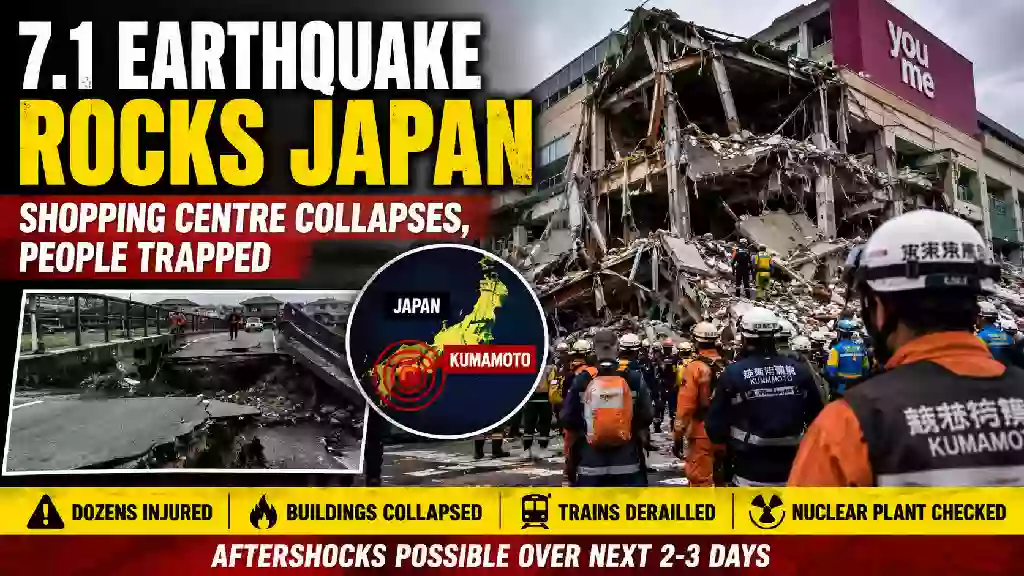
Rescue crews search through the debris of a collapsed shopping centre after a powerful 7.1-magnitude earthquake struck Kumamoto Prefecture, Japan, damaging infrastructure and prompting warnings of possible aftershocks.
Japan Launches Massive Rescue Operation After 7.1 Earthquake Collapses Shopping Centre
Powerful Quake Strikes Kumamoto as Officials Warn of More Aftershocks
Rescue teams are searching for survivors after a 7.1-magnitude earthquake struck Kumamoto Prefecture on Japan’s southwestern island of Kyushu, damaging buildings, disrupting transportation, and trapping people inside a partially collapsed shopping centre. The powerful quake injured dozens of people, prompted widespread emergency responses, and raised concerns about additional strong aftershocks in the coming days.
Authorities continue to assess the full scale of the disaster as firefighters, police, and rescue personnel work through damaged structures to locate anyone still trapped. While the initial tsunami threat has eased, officials are urging residents to remain vigilant as seismic activity continues.
Shopping Centre Collapse Sparks Urgent Rescue Effort
The most critical rescue operation is taking place at a shopping centre south of Kumamoto City, where witnesses reported an explosion followed by smoke coming from the building during the earthquake.
According to emergency officials, part of the mall’s second floor collapsed as the earthquake struck, raising fears that multiple people remain trapped beneath the debris. Rescue crews entered the damaged structure shortly after the quake to search for survivors while carefully evaluating the risk of further collapse.
Images from the scene show severe structural damage, with portions of the building reduced to rubble as emergency responders continue their search.
Buildings, Bridges and Rail Network Damaged
The earthquake caused significant damage across the affected region, impacting homes, commercial buildings, and public infrastructure.
Officials reported that at least 50 people were taken to hospital following the earthquake. Several buildings collapsed, fires broke out in multiple locations, and railway services were suspended after a train carriage was knocked off its tracks.
Infrastructure also suffered extensive damage. A section of a bridge partially collapsed into a river, leaving authorities to inspect surrounding roadways before allowing travel to resume. Power disruptions were also reported in parts of the region as emergency crews worked to restore essential services.
Government Assesses Extent of Disaster
Japan’s government has dispatched emergency assessment teams to evaluate the damage and coordinate rescue operations throughout Kumamoto Prefecture.
Officials are urging residents to monitor television, radio, and official emergency alerts for evacuation instructions or safety updates as rescue efforts continue.
As a precaution, inspections were also carried out at a nearby nuclear power facility. According to officials, no abnormalities were detected following the earthquake.
Shallow Earthquake Raises Concern Over Aftershocks
Experts say the earthquake occurred at a depth of approximately 10 kilometres, making it a relatively shallow event capable of producing particularly intense ground shaking.
Authorities warned that additional strong earthquakes could occur over the next two to three days, with numerous aftershocks already being recorded. Residents have been advised to avoid damaged buildings and prepare for the possibility of further seismic activity.
Emergency officials continue to emphasise that aftershocks can weaken already damaged structures, increasing the risk of additional collapses even after the initial earthquake has passed.
Region Recalls Previous Kumamoto Earthquakes
For many residents, the latest earthquake revived memories of the devastating earthquakes that struck Kumamoto nearly a decade ago.
Japan is recognised worldwide for its strict earthquake-resistant building standards and advanced emergency warning systems. While these measures have helped reduce the impact of many major earthquakes, officials acknowledge that powerful shallow earthquakes occurring near populated areas can still result in significant damage and complex rescue operations.
Emergency agencies continue to inspect roads, railways, bridges, and public buildings while supporting affected communities across the region.
Rescue Operations Remain the Top Priority
Search-and-rescue teams remain focused on locating people believed to be trapped inside the collapsed shopping centre while engineers assess the safety of damaged structures throughout Kumamoto.
Authorities have asked residents to remain cautious, avoid unstable buildings, and follow official safety guidance as aftershocks remain a possibility.
With emergency crews working around the clock, the coming days will be critical in determining the full extent of the damage and ensuring the safety of communities affected by one of Japan’s strongest earthquakes in recent years.
#JapanEarthquake #Kumamoto #Kyushu #BreakingNews #Earthquake #JapanNews #RescueOperation #NaturalDisaster #Aftershocks #WorldNews #EmergencyResponse